Some of the hardest things to see are the ones happening right in front of us.
A child struggling without the words to explain it.
And adults too busy to realize what’s really being said.
There are moments most of us recognize.
A child who is usually full of energy suddenly goes quiet.
Emotions that feel bigger than the situation.
A simple day that unexpectedly becomes overwhelming.
And in the moment, it is easy to explain it away.
“They’re just tired.”
“It’s just a phase.”
“They’ll grow out of it.”
Sometimes that is true. But sometimes it is not.
What is happening underneath is not always visible
Children do not always have the language to explain what they are feeling.
So instead, it shows up in behavior. Not always in obvious ways, but in small shifts like withdrawal, irritability, changes in focus, or emotional reactions that seem out of proportion to what is happening around them.
From the outside, it can look like behavior that just needs correcting.
But often, it is communication without words.
According to the Centers for Disease Control and Prevention, about 1 in 5 children experience a mental, emotional, or behavioral disorder each year. That means this is not rare or isolated. It is showing up in homes, schools, and communities everywhere.
The role we do not always realize we are playing
For many of us, including myself and a lot of our team at ACP, this day feels personal.
We are not just observing this from a distance. We are raising children, mentoring them, and shaping how they experience the world.
And when you are in that role, you start to realize something important. Children do not just develop from what we tell them. They develop from how they experience us in everyday moments.
Adults carry a lot. Work, finances, responsibilities, pressure. We do our best to manage it.
But children feel that environment too, even when nothing is said out loud. And they do not always have the tools to understand what they are absorbing or how to express it.
So it comes out differently. Sometimes as frustration. Sometimes as withdrawal. Sometimes as emotional intensity that does not seem to fit the situation.
Why it is often missed
It is not that people do not care. It is that the signs are not always clear.
A mood shift.
Less interest in things they used to enjoy.
Trouble focusing.
Emotional reactions that seem sudden or unpredictable.
On their own, they can seem small. Together, they can signal something deeper.
And without awareness, it is easy to overlook what is really going on.
The stigma that makes it harder to speak up
There is another layer that makes children’s mental health harder to address.
Mental health still carries a stigma that physical health does not.
When a child is physically sick, we act quickly. We ask questions. We seek help.
But when it is emotional or mental, the response is often slower, more uncertain, or avoided altogether.
That hesitation matters.
Because children notice it too. And it can make them less likely to express what they are feeling or ask for help when they need it most.
Research from the World Health Organization shows that stigma is one of the biggest barriers preventing young people from accessing mental health support early.
Why early experiences matter
Long-term research has shown just how important early childhood experiences are in shaping future health and wellbeing.
The Adverse Childhood Experiences (ACE) Study, conducted by the Centers for Disease Control and Prevention and Kaiser Permanente, found that early exposure to stress, trauma, or instability can significantly impact both mental and physical health later in life.
Higher ACE scores are linked to increased risk of depression, anxiety, and chronic health conditions.
What this tells us is simple. What happens early matters more than we often realize.
And more importantly, early support can change outcomes.
What children actually need
Kids do not need perfect responses.
They need consistency.
They need patience.
They need adults who stay present instead of dismissing what they are seeing.
They need space to feel what they feel without being shut down or overlooked.
Why this day matters
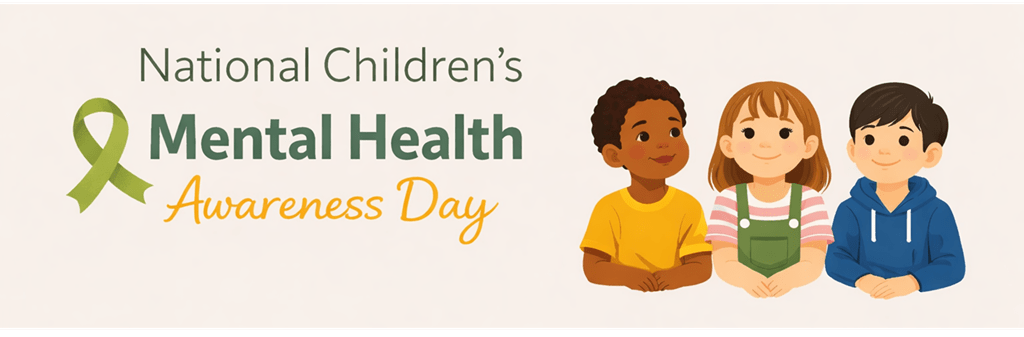
National Children’s Mental Health Awareness Day is not about statistics alone.
It is about recognizing that what shows up as behavior is often something deeper that has not been understood yet.
It is about understanding that mental health begins early and that awareness, patience, and support can shape a child’s future in real ways.
A final thought
Children are always communicating something.
They may not always have the words, but they show us in other ways.
And when we slow down enough to notice, we often realize it was never just a phase. It was a moment where they needed to be understood.